Showing posts with label lateral hip snapping. Show all posts

What To Do About Lateral Hip Snapping

"If you don't take care of your body, where will you live?"


My last blog post, Understanding Why The Hip Snaps, described anterior hip snapping which occurs at the front of the hip and lateral hip snapping which occurs along the outside of the hip.  Lateral hip snapping can be attributed to a tightening in the iliotibial band.


            The gluteus maximus and the tensor fascia lata muscles merge into this band, which is actually a tendon that attaches the two muscles to the skeleton.  Tightness in either of the two muscles, or in the actual tendon itself, can cause a snapping as the iliotibial band slides across the bony projection on the outside of the femur, or thigh bone, called the greater trochanter.


            The gluteus maximus begins at the lower spine and merges with the tensor fascia lata and connects to the leg via the iliotibial (IT) band.  It is responsible for returning the leg to its original position after it has been lifted to the front, lifting the leg in arabesque, and is one of the main muscles involved in turning the leg out.  It is a muscle that is used excessively in all kinds of dance and especially in forms like ballet and Irish dance since they require the dancers to be constantly turned out.

            The tensor fascia lata begins at the front of the pelvis and runs in front of the hip joint before it merges with the gluteus maximus in the IT band.  This muscle is responsible for lifting the leg to the front or the side and rotating it inward.  The constant raising of the legs required in dance relies significantly on this muscle.

            The tendinous IT band itself may also grow tight.  All of the muscles and tendons in our body are surrounded by a strong, fibrous, connective tissue that supports, protects, and holds the shape of the muscles and tendons called fascia.  Fascia is made of densely packed proteins called collagens.  When fasica is healthy, it is soft, elastic, and supple, but when it is irritated or inflamed from overuse, it becomes dry and its fibers contract, bunch up, and become “tangled”.  This bunching causes tightness, and since fascia is also filled with nerves, can be painful.

from www.itftennis.com
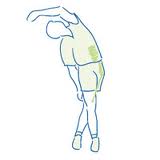
            Some immediate ways of dealing with a tight IT band are stretching the gluteus maximus and the tensor fascia lata muscles.  The gluteus maximus can be stretched by lying on the back with the legs extended, and then bending the right knee up toward the left shoulder and holding it for 20-30 seconds and repeating it with the left knee toward the right shoulder.  Dancers can also stretch this muscle by placing one leg up on the barre in a turned out front attitude position while leaning forward over the leg.
from www.physiohub.com
            The tensor fasica lata and the IT band can be stretched by holding onto a chair or barre with the right arm, crossing the right leg behind and around the left leg, pushing the left hip outward, and reaching the upper body to the right toward the barre or chair, holding it for 20-30 seconds, and repeating it on the other side.  This same exercise can also be done by crossing the legs, pushing the hip outward, and bending the upper body all the way over toward the floor.  Of course, it is important that the body be warm when doing any of these stretches.

            Another way to help eliminate some tightness would be to use a foam roller along the outside of the thigh.  Gentle pressure on fascia begins to soften the tissue, elongate the fibers, and “untangle” the bundles so that the fibers become supple once again.

            While the stretching is an immediate fix, it is important to be evaluated by a physical therapist with knowledge of dance medicine to determine how to create balanced hip muscles and keep this problem from becoming a chronic one.

Understanding Why the Hip Snaps


“We will be in tune with our bodies only if we truly love and honor them.” - Harriet Lerner


            The hip joint is an important one for all dancers to understand since it is responsible for flexing and extending the leg, rotating the leg inward and outward, and moving the leg away from the center of the body (abduction) and pulling the leg in toward the center of the body (adduction).

            The hip joint is a ball and socket joint which allows the leg to move in all different directions.  The head of the femur, or thigh bone, fits neatly into a pocket in the pelvis and is held in place by a web of different muscles, tendons, and ligaments.

            An often heard complaint from many dancers is that they hear and feel a snapping or popping in the joint during movements like grand plié and developpé.  The audible noise is a clicking sound, and dancers often simultaneously experience a shift in the skeleton, and it is referred to as hip snapping syndrome.

            The “snapping” of the hip occurs when a muscle or a tendon passes directly over a bone.  The two most common types of snapping at the hip are lateral hip snapping and anterior hip snapping. 

from www.online.epocrates.com
            Lateral hip snapping involves the iliotibial band which is the tendon portion the gluteus maximus and tensor fascia lata muscles.  It runs along the outside of the thigh and attaches to the skeleton near the top of the tibia, one of the bones found in the lower leg.  At the top of the femur, there a bony projection on the outside of the bone called the greater trochanter.  When the leg is extended, the iliotibial band lies just behind the greater trochanter, but when the leg bends, or flexes, at the hip joint, the iliotibial band passes over the greater trochanter and if the tendon or any of its muscles are tight, a snapping will occur as it slides across it.

from www.physioadvisor.com.au
            Anterior hip snapping happens at the front of the hip as opposed to the side of the hip and involves the iliopsoas, which is the merging of the iliacus and psoas muscles.  The iliacus begins at the inside back of the pelvis, while the psoas is attached to the lower vertebra, and they combine to attach to the inside of the femur on a small bony projection called the lesser trochanter.  When the leg is flexed, or bent at the hip, and turned out, the iliopsoas lays across the hip joint.  As the leg extends and moves toward the body, if the muscle is pulled tight, it will snap as it moves across the femoral head.

            Dancers may find that hip snapping syndrome occurs during a growth spurt since bones grow faster than muscles and muscles are taut until they catch up. 

            As long as this snapping is not painful, it does not indicate a serious problem, but it can be a sign of a muscular imbalance.  If the snapping occurs all of the time, there is a good chance that the bursa sacs surrounding the hip joint can become irritated.  The job of a bursa sac is to provide a cushion between soft tissue like muscles and tendons and bones to reduce friction. As the tight tendons and muscles rub closely against the bones the bursae may become inflamed and painful, resulting in bursitis. 

            Keeping the muscles of the hip joint healthy by embarking upon a supplemental conditioning program that strengthens and stretches all of the hip muscles equally will help eliminate any imbalances and contribute to healthy dancing.