
“There are three steps you have to complete to become a professional dancer: learn to dance, learn to perform, and learn how to cope with injuries.” - D. Gere
Last week’s
post on the anatomy of the ankle explained how the two joints that comprise the
ankle and the ligaments surrounding the ankle work. When everything goes as planned, the ankle
moves as it should and is prevented from moving in directions that could damage
and/or compromise its stability.
Sometimes, however, there are factors that cause the ankle to move in dangerous ways and an injury occurs.

Ankle
sprains account for 15% of all athletic injuries, and an ankle sprain is the
most common injury among all forms of dance.
A 2006 article published in Physical
Medicine and Rehabilitation Clinics of North America reported that ankle
injuries account for up to 62% of all dance injuries, up to 24% of all modern
dance injuries, up to 95% of all ballet injuries and up to 45% of musical
theatre dance injuries in professional dancers.
The same article reports that females are at a higher risk of injuring
the ankle because of the amount of stress placed on the joint during pointe
work.
A sprain
occurs when one or more of the ligaments surrounding the ankle joint are
overstretched or possibly torn. Since
ligaments are designed to prevent movements from occurring, an overstretched or
torn ligament allows for movement in a direction that the joint is not meant to
go.
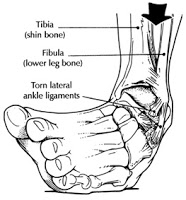 |
| Lateral sprain |
The most
common sprain among dancers is on the lateral, or outside, of the ankle. This sprain occurs in the lateral collateral
ligaments when the foot turns inward, or inverts, while the ankle rolls
outward. A less common sprain can occur
on the medial, or inner side, of the ankle if the foot twists outward, or
everts, while the ankle rolls inward.
Consequently, one or more of the deltoid ligaments and/or the
calcaneonavicular ligament can be overstretched. The least common type of sprain among dancers
occurs at the top of the ankle and is called a high sprain. It would involve the syndesmosis ligaments
that connect the tibia to the fibula.
Sprains can
caused by either rolling over when on demi-pointe or pointe, landing a jump incorrectly, or dancing on poor surfaces like slippery floors. Rolling over or a poor landing could be the
result of poor alignment at the ankle joint.
If a dancer’s foot tends to pronate, or roll in, the ankle may become
chronically misaligned. Ankle
misalignment can also occur if there are muscular imbalances in the leg, if
turnout is forced, or if there are misalignments in other parts of the
body. Fatigue and/or a sudden increase
in training or rehearsal time can also stress the body and cause it to respond
to movement differently than expected.
Slippery floors limit the amount of control a dancer has when dancing
and can cause unexpected movements or falls.
When a
sprain occurs, the dancer will experience immediate pain followed by
swelling. A mildly sprained ankle will
be swollen, be tender and stiff, and cause a small amount of pain when
walking. When the swelling and
tenderness are accompanied by bruising and extreme pain while walking, the
sprain is classified as serious or moderate.
A severe sprain often results in an audible pop or snap and a feeling of
tearing when it occurs. The ankle will seem
“wobbly”, and the dancer will be unable to walk on it.
As with all
injuries, the dancer should immediately stop dancing, ice the injured area, and
elevate it. The reasons for following
these steps are reviewed in my post on caring for injuries. Dancers should always be evaluated by a dance
medicine specialist. Depending upon the
severity of the sprain, the injury can take anywhere from 6 weeks to 3 months
to heal. After the injury heals, it is
important that the dancer work with a physical therapist to re-establish the
strength of the ankle joint and to determine what may have caused the
injury. If the cause was misalignment
and/or a muscular imbalance, a physical therapist can help the dancer retrain
his/her body to keep another injury from occurring.
__________________________________________
Kadel, N. (2006). Foot and Ankle Injuries in Dance. Physical Medicine and
Rehabilitation Clinics of North
America, 17, 813-26.
O’Loughlin, P., Hodgkins, C., & Kennedy, J. (2008). Ankle Sprains and Instability in
Dance. Clinics
in Sports Medicine, 27, 247-62.
Russell, J. (2010).
Acute Ankle Sprain in Dancers. Journal of Dance Medicine and
Science, 14(3), 89-96.


